

By Gulshan Mishra | Franchise Consultant | FranchiseZing.com | Updated 2026
Watch the full video: 5 Food Franchise Mistakes That Can Destroy Your Investment— YouTube
The ‘Meetha Dhoka’ That’s Costing Indian Investors Crores Every Year
You tried a burger at a new QSR outlet. It was incredible. The ambience was buzzing. The queue was long. And right then — the thought hit you: “Yaar, iski franchise mere shehar mein aag laga degi!”
Doston, that feeling? That is the beginning of the most common and most painful food franchise mistake in the Indian market.
In my 16+ years of franchise consulting, food sector failures are the most frequent — and the most heartbreaking. Not because the investors were foolish. But because they were making emotional decisions dressed up as business decisions.
Today, I’m going to break down the 5 most dangerous food franchise mistakes that drain your savings before you even complete six months. If you’re planning to invest in any food brand — from a chai stall to a pizza chain — read every word of this carefully.
For verified food franchise options with real margin data, start your research at FranchiseZing.com.
Food Franchise Mistake #1: Confusing Your Taste with Market Demand
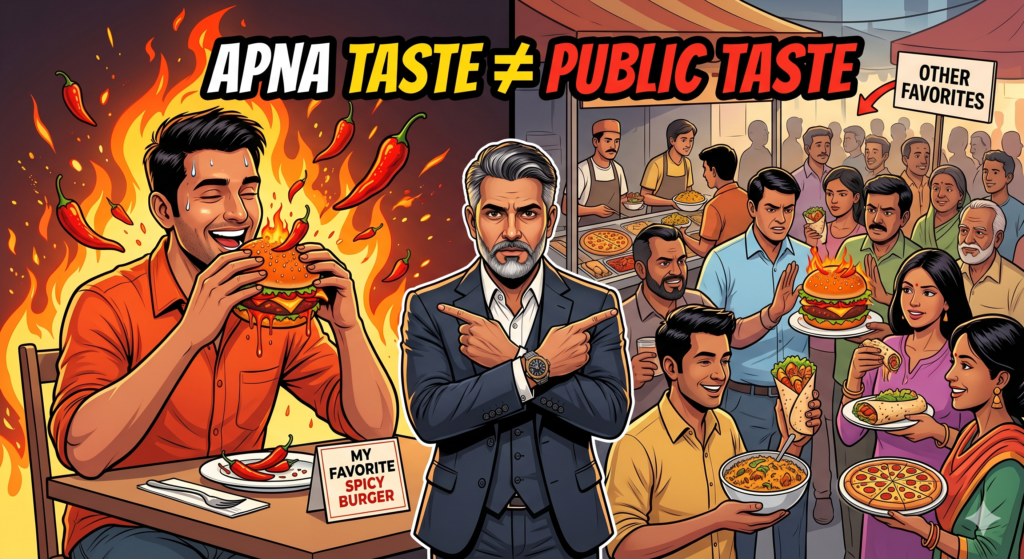
‘Apna Taste = Public Ka Taste’ — The Most Expensive Assumption in Food Business
This is the first and most seductive food franchise mistake. You loved the brand’s product. You became a fan. So you invested.
But here’s the brutal reality: your personal taste is not a business plan.
A highly spiced snack brand that you discovered in Pune might completely fail in Lucknow, where the palate is milder and more traditional. A trendy dessert cafe that works brilliantly in a metro college area might get zero footfall in a semi-commercial locality in Patna.
Dil aur zubaan se nahi, data se socho. Before investing, ask the brand for:
- Outlet performance data from Tier 2/3 cities specifically — not metro numbers dressed up as national averages.
- Local taste research — has the brand tested its product in your target city or neighbourhood?
- Average ticket size vs. the actual spending capacity of your local customer base.
Emotions get you excited. Data keeps you from losing ₹15–20 Lakh on the wrong brand in the wrong location.
Food Franchise Mistake #2: Depending on a ‘Khandani Ustad’ for Quality
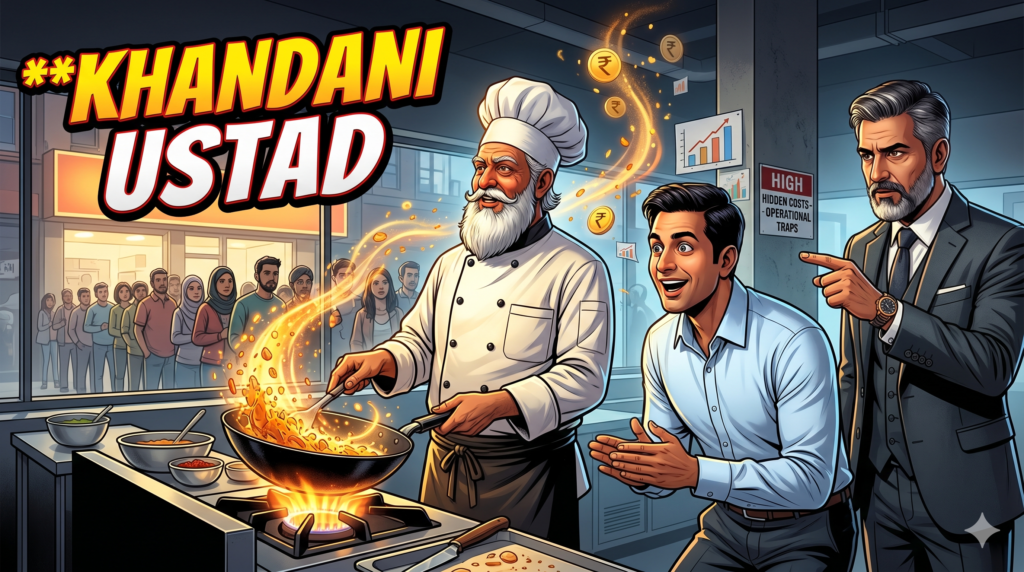
If the Brand’s Recipe Lives in One Chef’s Hands — You’re Sitting on a Time Bomb
This is the second, and deeply dangerous, food franchise mistake — one that very few salespeople will warn you about.
Some food brands — especially newer ones or regional players — base their entire product quality on one skilled chef or a small team with proprietary, non-replicable techniques. The biryani tastes extraordinary because Ustad ji makes it. Full stop.
What happens when Ustad ji takes a month off? Gets a better offer? Falls sick?
Aapka brand overnight ek ordinary kitchen ban jaata hai. And you — the franchisee — bear 100% of the revenue hit.
What should a solid food franchise system look like instead?
- Pre-mixes and standardised formulas — the brand’s recipe should be producible by a fresher trained for just 2-3 days.
- Automated equipment — machines that control cooking temperature, time, and portions automatically.
- SOPs (Standard Operating Procedures) — documented, visual, video-guided instructions that any team member can follow.
A great food brand removes human dependency, it doesn’t depend on it. Before investing, ask to see the training manual. If it doesn’t exist in a comprehensive written/video format — walk away.
Food Franchise Mistake #3: Ignoring the Dustbin Expense (Food Wastage)
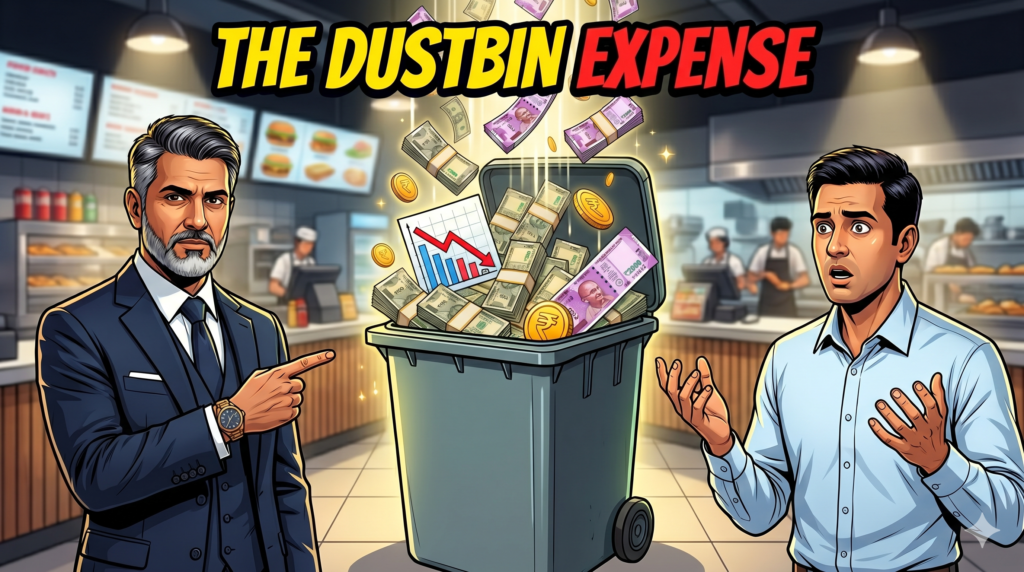
The Silent Killer That Eats Your Profit Before You Even Count It
The third food franchise mistake is one that the brand’s Excel sheet will never show you. In fact, if you look at most franchise pitch decks, this line item is missing entirely.
Food wastage.
Every day in a food business: tomatoes go bad, milk turns, bread expires, prepped ingredients go unused. In a poorly managed food outlet, wastage can eat up 8–15% of your daily revenue. That is not a small number.
Let’s put numbers to it. If your daily revenue is ₹15,000:
- 8% wastage = ₹1,200/day lost
- Monthly wastage cost = ₹36,000
- Annually = ₹4.32 Lakh literally thrown in the dustbin
And this is on a mid-performing outlet. Scale up the revenue, and the wastage scales with it — unless the brand has a tight inventory management system.
Before signing, demand to know: Does the brand have a daily inventory tracking system? Are par levels defined for each ingredient? Is wastage percentage monitored outlet-wise? If the answer is vague — that’s your answer.
Ground reality kya hai? A food franchise without wastage control is a business with a permanent slow leak. You’ll never fully plug it.
Food Franchise Mistake #4: Paying Premium Rent for a Delivery-First Brand
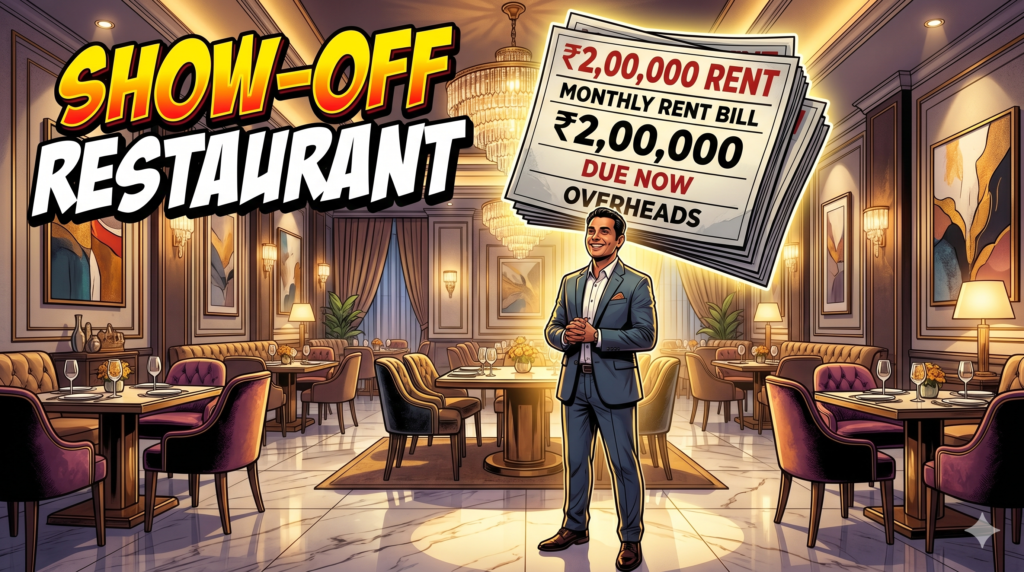
Dine-In Ka Show-Off, Delivery Ka Paisa — Ek Dangerous Mismatch
The fourth food franchise mistake is an expensive ego trap. Investors spend ₹1.5–2 Lakh per month on a high-street, large-format dine-in location for a brand that gets 80% of its orders from Swiggy and Zomato.
Think about that for a second. Your premium ₹2 Lakh rent is being seen by delivery drivers, not customers. The customer ordering online couldn’t care less whether your kitchen has Italian marble or a bare concrete floor.
In 2026, the distinction is clear:
- Dine-in heavy brands (fine dining, premium cafe, experiential restaurants) — location and ambience matter. Invest in it.
- Delivery-first and hybrid brands (QSR, cloud kitchen, tiffin, quick bites) — a smaller space in a ₹40,000–₹60,000/month location does the same job at a fraction of the cost.
Do the math before you rent:
- High-street rent: ₹2 Lakh/month
- Cloud kitchen / smaller unit rent: ₹45,000/month
- Annual saving by right-sizing: ₹18.6 Lakh
That ₹18.6 Lakh over three years could fund a second outlet entirely. Rent bachaiye, dusri dukan kholiye.
Explore right-sized food franchise formats matched to your city and budget at FranchiseZing.com.
Food Franchise Mistake #5: Ignoring Delivery App Commission in Margin Calculations

The Aggregator Trap: 100 Rupaye Mein Se Sirf 40 Rupaye Teri Jeb Mein
This is the most painful food franchise mistake — and one that catches even experienced investors off-guard.
You sell a ₹200 burger combo. You think: ₹200 revenue, great! Here’s what actually happens:
- Delivery App commission (25–30%): ₹50–₹60 gone
- Packaging cost: ₹15–₹20 gone
- Discount/offer cost (platform mandates): ₹10–₹20 gone
- Raw material cost (35–40%): ₹70–₹80 gone
- Royalty (if applicable): ₹8–₹12 gone
- What’s left before rent and staff: ₹10–₹30. Sometimes less.
This is why many food franchise investors find themselves working 12-hour days and still showing near-zero profit at month-end. The maths was never right to begin with.
A brand that doesn’t pre-calculate delivery commissions into its unit economics is selling you a dream with someone else’s margin structure. Aakhir mein haath mein sirf chillhar aati hai.
Before investing in any food franchise, demand a P&L simulation that includes delivery commissions, platform discounts, and packaging costs. If the brand can’t produce one — that tells you everything.
What Does a Realistic Food Franchise P&L Look Like? (Tier 2 City Example)
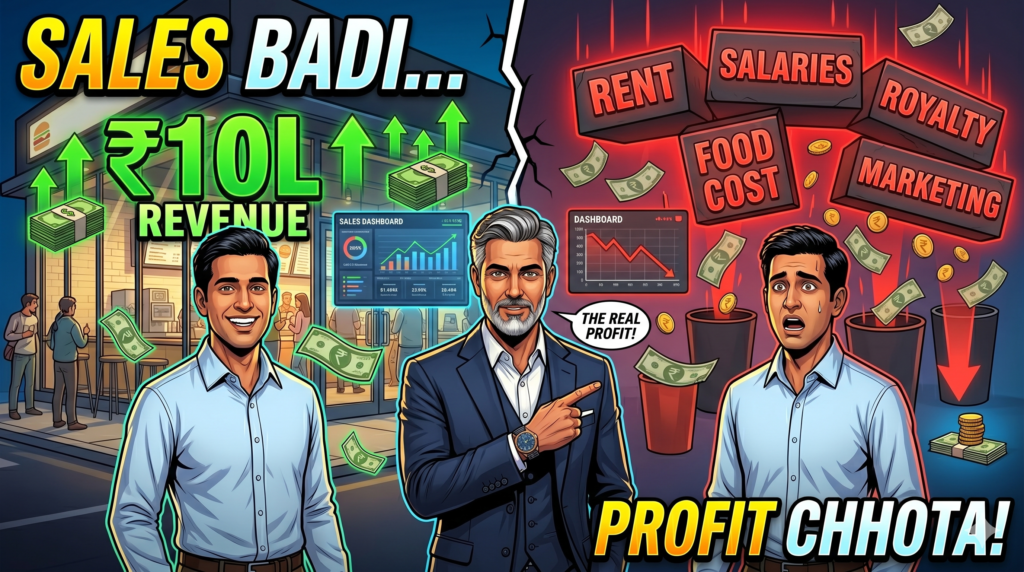
Let’s take a mid-size QSR food franchise in Nagpur. Total investment: ₹18 Lakh. Here’s a realistic monthly picture:
- Monthly revenue: ₹4.5 Lakh (mix of dine-in and delivery)
- Raw material cost (38%): ₹1,71,000
- Rent (right-sized location): ₹55,000
- Staff (3 people): ₹45,000
- Delivery platform commissions: ₹54,000 (on ₹2L delivery orders @27%)
- Royalty (5%): ₹22,500
- Packaging + utilities: ₹18,000
- Net profit: ~₹84,500/month (18.8% margin)
This is a healthy unit — but only because every cost line was pre-calculated. Change the rent to ₹1.5 Lakh and the net profit drops to under ₹20,000. That’s the difference between a gold mine and a trap.
Real-Life Case Study: Deepak vs. Arjun — Same Brand, Same City, Opposite Results
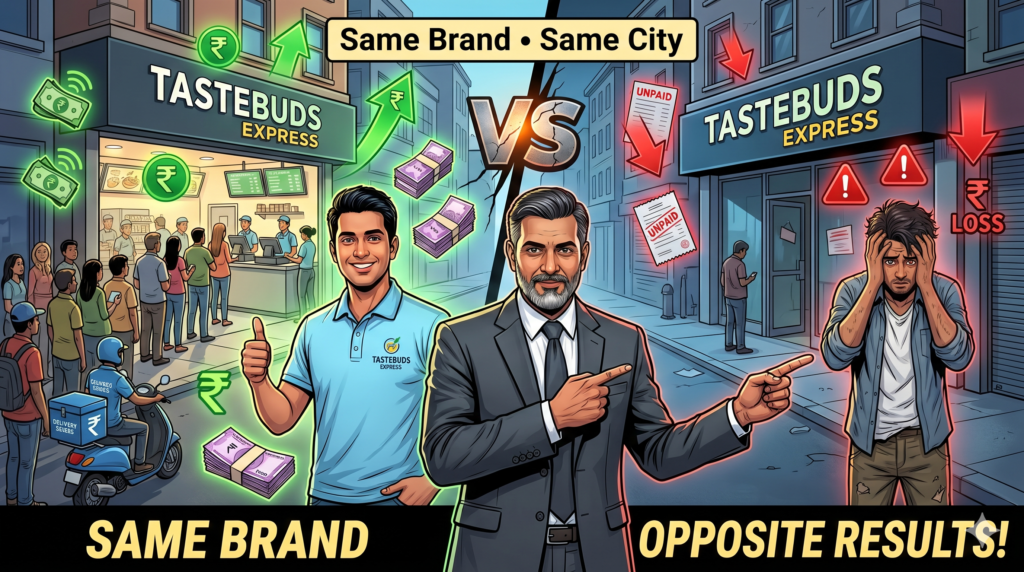
Deepak’s Story — The Trap
Deepak, 38, from Kanpur, invested ₹22 Lakh in a fast-food franchise. He loved the brand’s product and secured a high-street location at ₹1.8 Lakh/month rent, expecting the footfall to justify it.
What he didn’t check: 75% of the brand’s orders came via Delivery App. His high-street advantage was invisible to delivery customers. By month 5, after delivery commissions, packaging, rent, and royalty — he was making ₹8,000/month net profit on ₹22 Lakh invested.
He exited at month 10, losing over ₹12 Lakh. The food franchise mistake wasn’t the brand — it was the wrong format for the brand’s actual order pattern.
Arjun’s Story — The Win
Arjun, 31, from the same city, also took the same brand’s franchise. But he hired a consultant first. The consultant’s analysis showed delivery dominance, so Arjun took a smaller 300 sq ft hybrid unit at ₹50,000/month rent.
Same brand. Same city. But Arjun’s P&L showed ₹72,000/month net profit by month 4. By year 2, he opened a second outlet.
The difference? Format fit and financial modelling — not luck.
To get your food franchise investment modelled correctly before you commit, explore FranchiseZing.com/franchise-investment-asssessment-report.
The Consultant’s Checklist: 5 Non-Negotiable Questions Before Any Food Franchise Investment
Business mein emotion nahi, calculation hoti hai. Print this list and take it to your next franchise meeting:
- 1. What is the split between dine-in and delivery orders in existing outlets? Get this number before choosing your location size and rent.
- 2. Is the brand’s recipe system-dependent or chef-dependent? Ask to see the training SOP manual. Request a product demo using a trainee, not the head chef.
- 3. Show me a P&L that includes Swiggy/Zomato commission. If they can’t produce one, their unit economics haven’t been calculated with Indian market reality.
- 4. What is the average daily wastage percentage in existing outlets? Any brand serious about margins tracks this number. If they don’t know it — be worried.
- 5. Can I speak to 3 franchisees in Tier 2/3 cities specifically? Metro numbers do not translate. You need peers from your kind of market.
FAQ: Top 5 Questions on Food Franchise Mistakes
Q1: Is a food franchise in a Tier 2 city less risky than a metro?
Not inherently. The investment is lower, but so are the margins and the customer’s average spend. The risk lies in choosing a brand not optimised for smaller city volumes and spending patterns. A food franchise mistake in a Tier 2 city hurts just as badly — because you have less cushion to absorb losses.
Q2: Should I avoid cloud kitchen models?
Not at all. Cloud kitchens are highly viable in 2026 — especially for delivery-first brands. The key is choosing a brand with strong Swiggy/Zomato rating history, repeat order rates, and a delivery commission structure that still leaves meaningful margin. The model itself isn’t the risk; the margin math is.
Q3: How do I calculate if my food franchise investment will recover?
Take your total investment and divide by your expected monthly net profit (after ALL costs including delivery commissions). If your total investment is ₹18 Lakh and net profit is ₹60,000/month, your payback is 30 months. Anything beyond 36 months is a red flag for a food franchise.
Q4: What’s the biggest hidden cost most people miss?
Delivery platform commissions — by far. Most investors calculate raw material, rent, and royalty. Almost nobody factors in that 25–30% goes to Delivery Apps before you touch a rupee. This single food franchise mistake has wiped out the profitability of hundreds of outlets across India.
Q5: How do I find a food franchise with solid SOPs?
Ask the brand to walk you through the onboarding training program. If it’s 3–5 days of structured, documented, video-based training that produces consistent output — the SOPs are real. If it’s ‘you’ll spend time with our head chef’ — that’s the Khandani Ustad trap in disguise. Research verified brands at FranchiseZing.com.
Food Franchise — Gold Mine or Trap? It Depends on What You Do Before You Sign
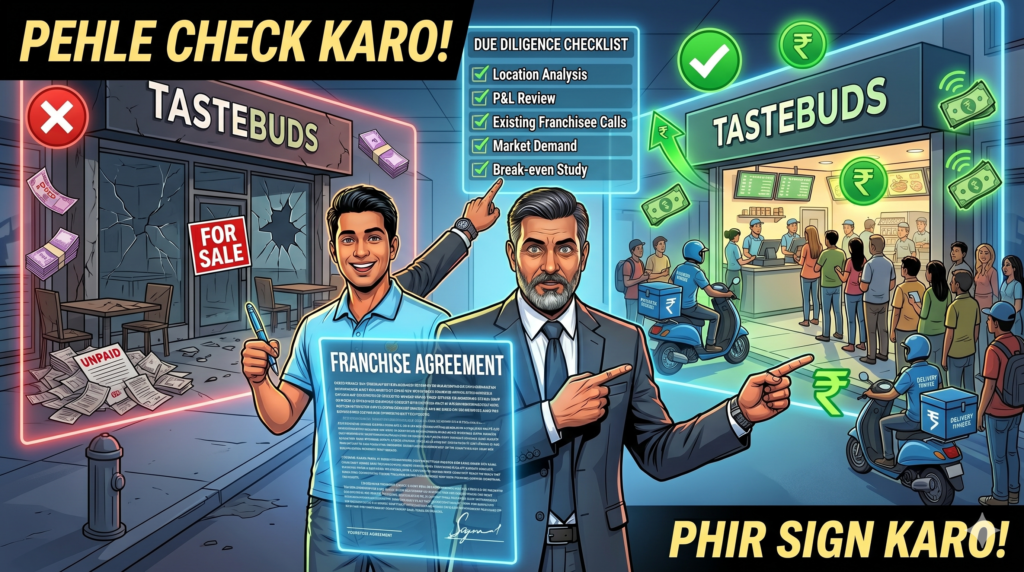
The food industry in India is genuinely one of the most profitable franchise sectors. People have to eat — recession or boom, festival or lockdown. The market is massive and the opportunity is very real.
But most investors commit at least one food franchise mistake from this list. Some commit all five. And by the time the losses show up, the franchise agreement is already signed, the deposit is paid, and the option to walk away is gone.
The investors who win are not smarter. They are simply more deliberate. They ask harder questions, run the numbers honestly, and choose format over fancy locations.
If you want me to personally evaluate any food franchise brand’s margin structure, SOP quality, and real unit economics — so you avoid every food franchise mistake on this list — drop a comment with “FRANCHISE” below. I’ll send you my exclusive Free Investment Assessment Report Tool that cuts through the marketing and gives you only mathematically proven brands.
Because meetha dhoka dekhne mein achha lagta hai — par paisa toh kadwa hi jaata hai.
Watch the full breakdown: Food Franchise Lene Ka Meetha Dhoka — YouTube
Explore verified, margin-proven food franchise options at FranchiseZing.com.
About the Author: Gulshan Mishra is the Founder of FranchiseZing and an independent Franchise Consultant with 16+ years of experience in franchise consulting, due diligence, and franchise investment advisory. He regularly publishes educational articles and videos to help entrepreneurs make informed franchise investment decisions.
© 2026 FranchiseZing.com | All Rights Reserved