

By Gulshan Mishra | Franchise Consultant | FranchiseZing.com | Updated 2026
Watch the full video: Master Franchise: Bada Munafa ya Bada Dhoka? — YouTube
The ₹50 Lakh Dream That Quietly Becomes a Nightmare
Picture this. You pay ₹50 Lakh for a master franchise of a rising brand. You’re told you now own the rights to an entire state. Every new outlet that opens in your territory will bring you a cut of the franchise fee and monthly royalties. Passive income. Empire building. The works.
Six months later — no new sub-franchisees have come on board. Your ₹50 Lakh is locked inside a master franchise trap: a thick agreement that gives you a grand title and very little actual power.
Doston, in 16 years of franchise consulting, the master franchise trap is one of the most glamorous-looking and most punishing mistakes I have seen Indian investors make. Not because master franchise is always bad. But because it is almost always sold wrong and bought blind.
This article is your reality check before you write that cheque. Read it fully before you sign anything.
For a verified list of franchise opportunities with transparent structures, start at FranchiseZing.com.
What Is a Master Franchise? The ‘Raja’ Pitch vs. The Postman Reality
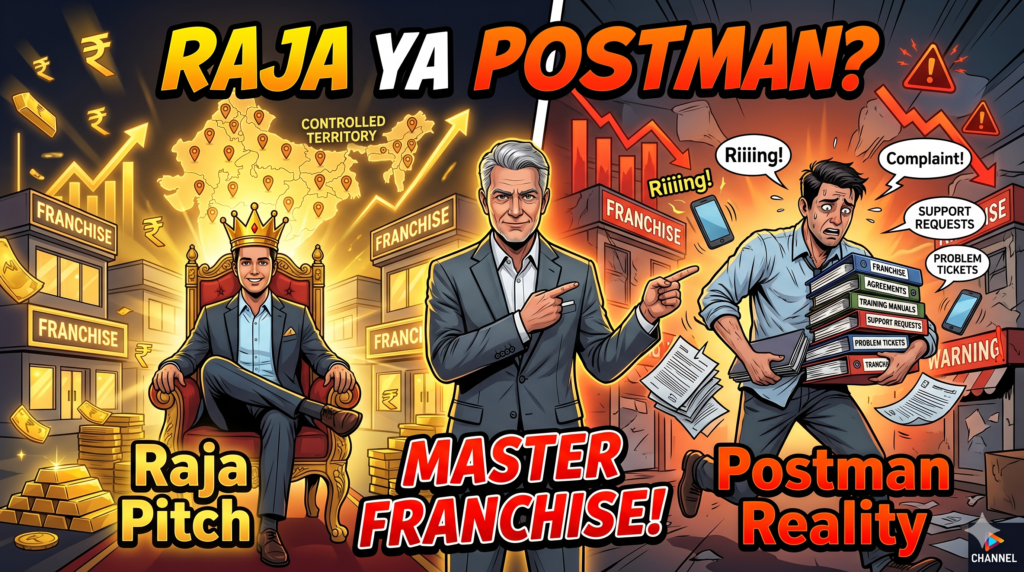
How the Master Franchise Is Sold to You
The pitch sounds extraordinary. You are not just buying a single outlet — you are buying the exclusive rights to develop an entire region. You get a share of every franchise fee collected in your territory. You get a slice of every month’s royalty from every sub-franchisee operating under you. You become the regional boss of the brand.
Brands love master franchisees for real reasons: local language fluency, community trust, market knowledge, and faster on-ground expansion. These are legitimate needs.
The master franchise trap begins the moment they sell you the title of Raja without giving you the power of Raja.
The Ground Reality: Most Master Franchisees End Up as Postmen
In the majority of master franchise arrangements I have analysed, the ‘master’ franchisee functions as an expensive middleman. You receive inquiries that the brand forwards to you. You explain the model to prospects. You negotiate on behalf of the brand. You onboard sub-franchisees. You handle complaints.
In short — you do the brand’s sales and expansion work, with your own capital at risk, and you get called a ‘partner’.
Aap Territory ke Raja nahi, brand ke paid sales agent ban jaate hain — except the brand didn’t pay you. You paid them.
The Master Franchise Trap #1: Blocked Capital and Hidden Expenses
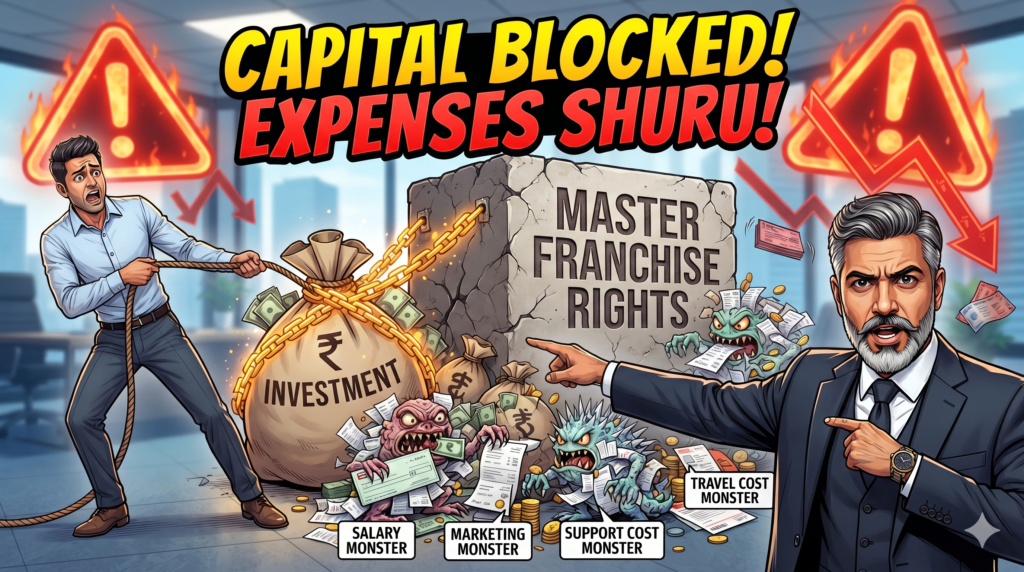
Master franchise fees in India typically range from ₹25 Lakh to ₹2 Crore+, depending on the brand’s scale and the territory size. This is a large amount of capital that gets locked into one agreement.
The dangerous assumption most investors make: sub-franchisees will start joining fast, and the fee income will recover my investment. In reality, this timeline is almost never what the agreement specifies.
The Hidden Expense Shock
Here is where the master franchise trap compounds itself. Most agreements state that the parent brand will support marketing and lead generation to help the master franchisee find sub-franchisees.
In practice? The brand does national-level marketing for the overall brand. Hyper-local expansion in your specific territory is your problem.
So you end up spending from your own pocket on:
- Local exhibitions and franchise expos: ₹1–3 Lakh per event
- Regional digital advertising: ₹30,000–₹80,000/month
- Salary for a sales executive to handle leads: ₹25,000–₹50,000/month
- Office or showroom space to meet prospects: ₹20,000–₹60,000/month
Add this up for 18–24 months while you wait for sub-franchisees to join, and the hidden cost of operating the master franchise easily runs to ₹15–25 Lakh additional — money nobody mentioned during the sales pitch.
Yes, when a new outlet does open, you get a larger cut of the franchise fee (sometimes 50–60%) and a share of monthly royalty. But if the leads aren’t converting — that fee share remains theoretical income. Kagaz par paisa, haath mein kuch nahi.
The Master Franchise Trap #2: The Royalty Loop That Works Against You
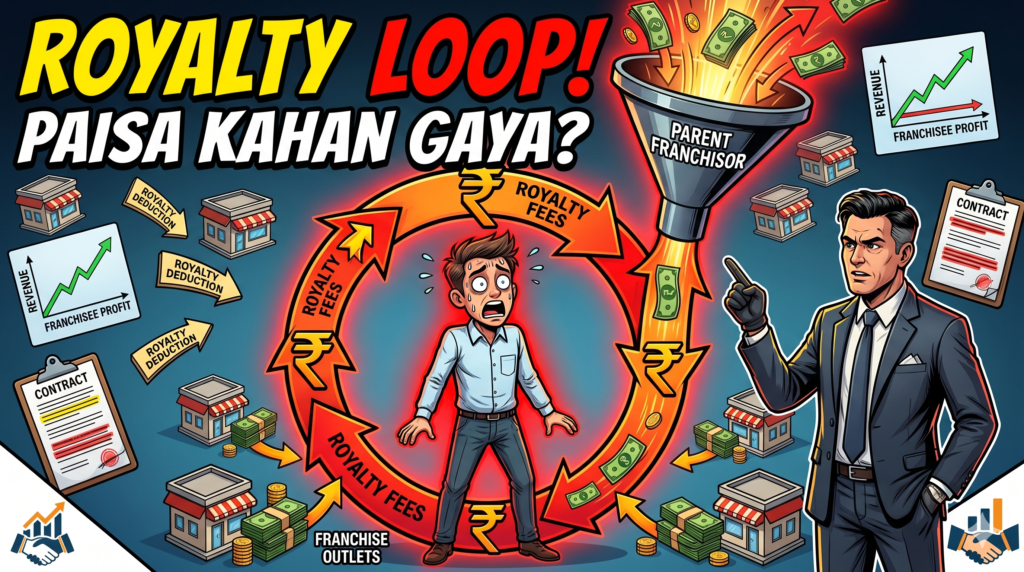
You Collect What the Brand Fails to Deliver
In a typical master franchise structure, you are responsible for collecting monthly royalties from your sub-franchisees and remitting the brand’s share upward. This seems simple. It isn’t.
Here is the master franchise trap in its most painful form. When the parent brand is slow on support — delayed stock, inconsistent training, poor marketing for the outlets — sub-franchisees get frustrated. They start delaying royalty payments. Some stop paying entirely.
The brand holds you accountable for collecting it. But the reason sub-franchisees are withholding royalty is the brand’s own service failure. You are now caught between an angry sub-franchisee below you and an impatient brand above you. And since you are the local face, the anger is directed at you.
Aapka naam kharab hota hai — brand ka nahi.
The Brand Conflict No One Warns You About
As a master franchisee, you often develop deep local market insight. You know which products work in your region, which pricing needs adjustment, and which marketing angles resonate. So you advise the brand.
The brand listens — or doesn’t. That choice is entirely theirs. When they ignore your ground-level intelligence and make decisions that hurt performance in your territory, your investment suffers while their brand equity remains intact.
This is not partnership. This is a very expensive advisory role with no veto power.
What Does a Master Franchise Investment Actually Look Like? Real Numbers for a Tier 2 Scenario
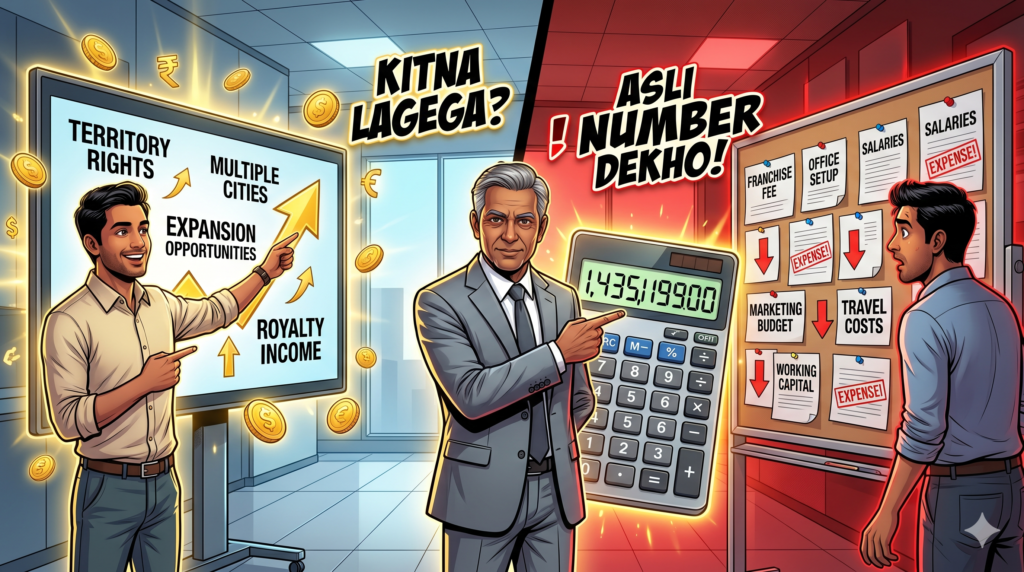
Let’s build a realistic picture. You are in Bhopal, and you purchase a master franchise for a mid-size food brand covering Madhya Pradesh.
Entry Investment:
- Master Franchise Fee: ₹40 Lakh
- Mandatory own-outlet setup (often required): ₹15 Lakh
- Office setup + local team: ₹5 Lakh
- Year-1 marketing spend (exhibitions, ads): ₹8 Lakh
- Total Year-1 Capital Required: ₹68 Lakh
Revenue Scenario (if 4 sub-franchisees open in Year 1):
- Your cut of each franchise fee (₹5L per outlet, 50% share): ₹10 Lakh total
- Monthly royalty share (4 outlets × ₹8,000): ₹32,000/month = ₹3.84 Lakh/year
- Own outlet profit (if profitable): ₹60,000/month = ₹7.2 Lakh/year
- Total Year-1 Income: ~₹21 Lakh
Against ₹68 Lakh invested — that is a payback period of over 3 years, if all assumptions hold. If only 1–2 sub-franchisees open in Year 1? You are looking at 6–8 years or a significant loss.
Yahi hai asli maths. Aur yahi hai jo sales pitch mein nazar nahi aata.
Real-Life Case Study: Vikram vs. Priya — Master Franchise, Two Very Different Fates

Vikram’s Story — The Trap (Jaipur)
Vikram, 42, from Jaipur, purchased a master franchise for a salon chain covering Rajasthan. He paid ₹35 Lakh as master franchise fee and set up his own flagship salon for another ₹12 Lakh.
The brand promised marketing support for sub-franchisee recruitment. What arrived: a logo-printed banner and access to their generic brochure. Vikram spent ₹6 Lakh of his own money on two franchise expos — and signed zero sub-franchisees in 18 months.
His own salon was profitable (₹45,000/month net), but it barely covered his operating costs. His ₹35 Lakh master fee was effectively dead capital. He eventually renegotiated his agreement — at a painful discount — to convert to a single-unit franchisee and walk away from the master arrangement.
Loss on master franchise dream: approximately ₹28 Lakh in locked and wasted capital.
Priya’s Story — The Win (Pune)
Priya, 36, from Pune, was approached with a similar master franchise opportunity for a tutoring brand. Before signing, she did three things: hired a consultant, spoke to existing master franchisees of the brand in other states, and demanded a clause guaranteeing a minimum number of brand-generated leads per quarter.
The brand agreed — and delivered. By month 10, four sub-franchisees had opened. By year 2, Priya’s territory had eight outlets, generating ₹1.1 Lakh/month in combined royalty income plus her own centre profit.
She recovered her ₹30 Lakh master fee by the 28th month.
The difference? Contractual lead commitment and pre-investment due diligence — not luck.
To get your own master franchise opportunity evaluated by an expert before you invest, visit FranchiseZing.com/franchise-investment-asssessment-report.
The Consultant’s Checklist: 5 Non-Negotiable Questions Before Buying Any Master Franchise
Bade title ke peeche mat bhagiye. Mathematical munafe ke peeche bhagiye. Here are the five questions that separate the genuine opportunity from the master franchise trap:
- 1. Is the base unit model already profitable? Ask for audited financials from at least 5 single-unit franchisees in comparable cities. If the base model is struggling, master franchise will amplify that pain, not solve it.
- 2. What lead generation will the brand provide — in writing? Get a contractual commitment specifying the number of qualified leads the brand will deliver to you per quarter. If they won’t put it in writing, the ‘support’ is a verbal promise with zero legal weight.
- 3. What is the refund or exit clause if you don’t hit sub-franchisee targets? If 3 years pass and you’ve only opened 2 outlets against a target of 10, what happens to your master fee? Clarity here separates serious brands from ones that just want your upfront capital.
- 4. Speak to 3 existing master franchisees — not brand-selected ones. Call them cold. Ask about actual lead support, royalty collection challenges, brand conflicts, and whether they would make the same investment again. Their answers will tell you everything.
- 5. What are the sub-franchisee’s actual unit economics? Your income depends on sub-franchisees succeeding and paying royalty. If their numbers are tight, they will exit or default. Verify their real P&L — not the brand’s projected P&L — before you commit.
FAQ: Master Franchise in India — Your Top 5 Questions Answered
Q1: Is master franchise always a bad investment?
No — but it is a high-stakes investment that demands a very different level of due diligence. The master franchise trap catches investors who treat it like a larger version of a single unit. It isn’t. It is a business-within-a-business that requires sales capability, local market management, and contractual protection. Done right, with the right brand, it can be genuinely wealth-building.
Q2: What is a realistic ROI timeline for a master franchise?
In most legitimate cases, a well-structured master franchise with active brand support takes 3–5 years to recover the master fee investment. If any brand tells you 12–18 months, demand their existing master franchisee’s actual financials to verify that claim. Promises without proof are part of the trap.
Q3: How large should my territory be?
Smaller is safer when starting out. A single city or a defined cluster of districts is more manageable than a full-state territory for a first-time master franchisee. A focused geography gives you higher sub-franchisee density, lower travel costs, and faster local brand awareness — all of which make your income timeline more realistic.
Q4: What happens if sub-franchisees exit or fail?
This is a critical risk point in the master franchise trap. If sub-franchisees close, your royalty income drops. Some agreements allow you to take over a failed sub-franchisee outlet — which creates additional capital pressure. Always ask: what is the brand’s sub-franchisee exit rate across existing master territories before you buy in.
Q5: Can I negotiate the master franchise fee?
Yes, in many cases — especially if you bring an existing network, a strong local reputation, or are willing to commit to a higher outlet-opening target. However, negotiate terms and support commitments even more aggressively than price. A ₹5 Lakh discount on the master fee means nothing if the lead-generation clause is vague. Explore your negotiation position with expert help at FranchiseZing.com.
Conclusion: Master Franchise — Empire Builder or Capital Trap? Here’s How to Know
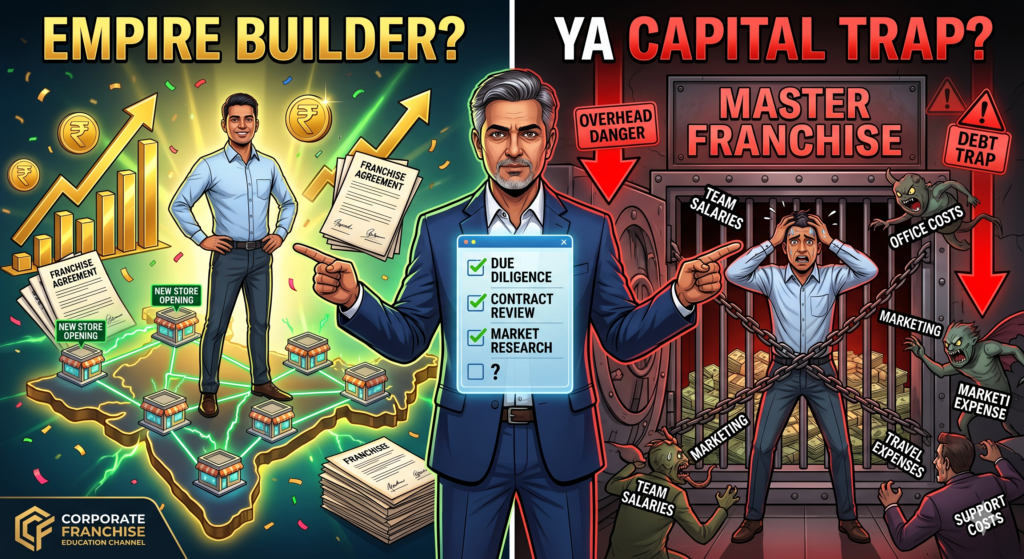
Doston, the master franchise trap is not a story about bad brands or dishonest salespeople alone. It is a story about decisions made without enough information.
A master franchise, in the right brand with the right contractual protections and realistic financial modelling, can be one of the most powerful wealth-building tools available to an Indian entrepreneur today. You genuinely can build an empire.
But walk in without due diligence — dazzled by the title, the territory map, and the passive income pitch — and you will find yourself sitting on a large sum of blocked capital, running someone else’s expansion for free, and wondering how it all went wrong.
Bade title ke peeche mat bhagiye. Mathematical munafe ke peeche bhagiye.
If you are seriously considering any master franchise opportunity and want to know whether it is genuinely viable for your city, your capital, and your timeline — comment “FRANCHISE” below. I will personally send you my exclusive Free Investment Assessment Report Tool that breaks down any master franchise model to its mathematical truth and tells you clearly: empire banayega, ya bank balance khali karega.
Watch the full video analysis: Master Franchise: Bada Munafa ya Bada Dhoka? — YouTube
Research verified franchise opportunities with expert consultation at FranchiseZing.com.
© 2026 FranchiseZing.com | All Rights Reserved
About the Author: Gulshan Mishra is the Founder of FranchiseZing and an independent Franchise Consultant with 16+ years of experience in franchise consulting, due diligence, and franchise investment advisory. He regularly publishes educational articles and videos to help entrepreneurs make informed franchise investment decisions.