

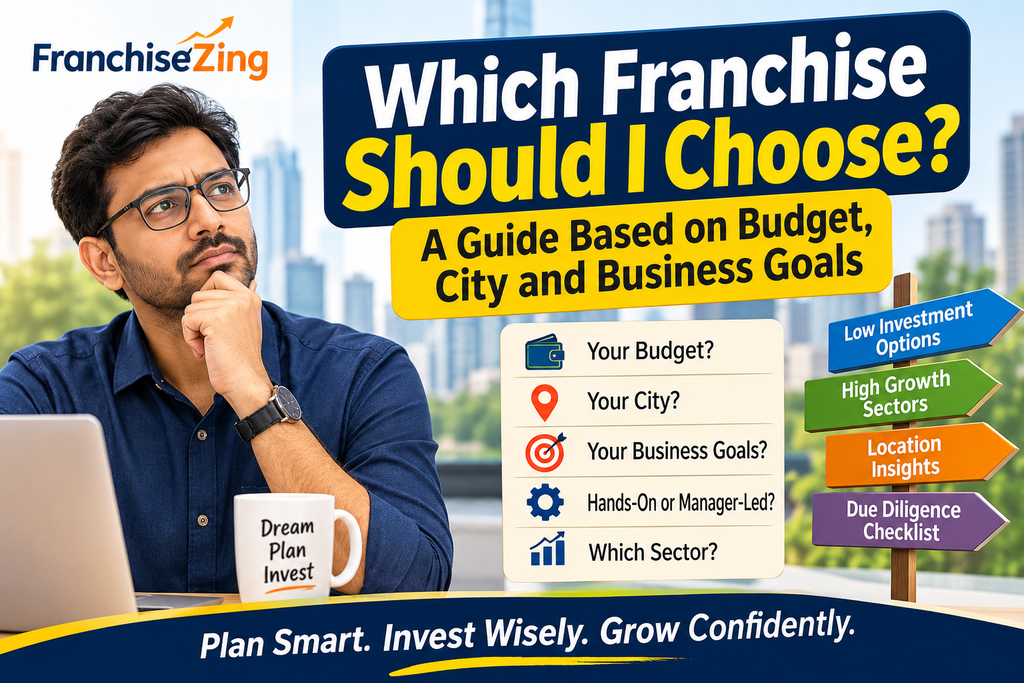
Open any business portal and you will find hundreds of franchise opportunities in India, from tea cafés and tutoring centres to pharmacies and salons. Each promises a proven model. That is the problem: when every option sounds good, choosing between them turns into guesswork.
So, which franchise should I choose? Start with yourself, not the brand. This guide shows how to work out what you can afford, what you can realistically earn and how much time you can give, so your options narrow before you meet a single salesperson. It is written for salaried professionals and first-time owners investing their own savings.
Which Franchise Should I Choose? The Direct Answer
Choose the franchise whose total investment, daily demands and risk level match your finances, your city and your lifestyle. Four factors decide that fit:
- Budget: what you can invest and still keep a financial cushion.
- Local demand: whether people nearby will buy the product, repeatedly.
- Operational involvement: how many hours you can personally give.
- Risk tolerance: how long you can wait for returns, and what loss you could absorb.
No franchise suits everyone, and none is guaranteed to be profitable. Treat any brand that claims otherwise as a warning sign.
Step 1: Set an Affordable Investment Range
Your real investment is larger than the franchise fee. Plan for three layers: setup cost (fees, fit-out, equipment, deposits), working capital (rent, salaries and stock until the outlet breaks even) and a personal reserve.
Protect Your Personal Reserve
Keep household expenses covered separately from the business. As a planning assumption, adjustable to your situation, set aside at least six months of living costs, including loan EMIs. Never commit money meant for children’s education, medical needs or retirement.
Ask every brand to list one-time and recurring costs in writing, then compare totals rather than headline fees. This is the core of franchise investment readiness, and it finds the best franchise for your budget more reliably than any ranking.
Step 2: Separate Target Income from Realistic Profit
Target income is what you want to take home each month. Realistic profit is what remains after rent, salaries, royalties, utilities, taxes and loan repayments. They are rarely the same, especially in year one.
Which Franchise Should I Choose for My Income Goal?
Fix the monthly take-home you need first. Add the costs above to see the sales required, then ask whether your local market can support that figure. Assume a slow start.
Ask the brand for outlet-level figures and verify them with existing owners. Promotional examples and brand-wide averages do not predict your result.
Step 3: Match the Business to Your City
Which franchise should I choose for my city? A model that works in a metro may struggle in a Tier 2 or Tier 3 town, so franchise business by city needs its own research. Check four things:
- Customer demand: who buys, how often and at what price point.
- Local competition: visit comparable outlets at different times and note footfall.
- Property costs: compare rent, deposit and lease terms with the sales you could plausibly make.
- Catchment: offices, colleges, homes and transport links near your proposed site.
Smaller cities often mean lower rent but also lower spending per customer, so neither a metro nor a small town is automatically better. Your own ground research matters more than the brand’s general pitch.
Step 4: Choose Between Hands-On and Manager-Run Ownership
- Owner-operated: you work in the business daily. You save on salary and control quality directly, but it is effectively a full-time job.
- Manager-run: you hire someone for daily operations. This suits people who keep a day job, but it adds salary cost, needs supervision systems and makes results depend on one person.
Be honest about your hours when deciding which franchise should I choose. If you plan to stay employed, price a competent manager into your profit estimate from the start. Semi-absentee does not mean passive.
Step 5: Compare Sectors Without Chasing a “Best” One
Every sector has trade-offs. Use these as starting points when comparing franchise investment options, not as rankings:
- Food and beverage: frequent customers, but perishable stock, staffing demands and rent sensitivity.
- Education and training: trust-driven and often seasonal; reputation can take time to build.
- Retail: depends on inventory control and a strong location.
- Services (health, wellness, home): rely on skilled staff, compliance and customer trust.
Investor Profiles: Illustrative Examples
This table is a thinking aid, not a recommendation. Your own numbers should override it.
| Profile | Main priority | Formats to explore |
| Salaried professional keeping the job | Manager cost and supervision systems | Manager-run formats with clear operating manuals |
| First-time owner, lower budget, full-time availability | Low fixed costs and lean working capital | Compact, owner-operated formats; a sensible start for franchise business for beginners |
| Existing small-business owner | Using spare space, staff or customers | Complementary formats that fit current premises |
| Higher budget, long-term horizon | Support systems, renewal and exit terms | Multi-unit or larger formats, only after thorough review |
Franchise Selection Checklist: Questions to Ask Before Shortlisting Brands
- What is the total investment, including every recurring fee, in writing?
- How many outlets run in cities like mine, and how many have closed?
- Can I speak with several current owners, including struggling ones, without brand staff present?
- What training and ongoing support are promised, and where is it written in the agreement?
- What are the royalty, marketing fund and renewal terms?
- Who controls pricing, suppliers and site approval?
- What are the exit, transfer and termination conditions?
- What break-even period does the brand claim, and what data supports it?
How Due Diligence and Comparison Narrow the Options
Treat your criteria as filters. Budget removes some brands, your city removes others and your preferred involvement removes more. Then apply due diligence to the two or three that remain: read the agreement, speak with current owners and test every claim for evidence. This is the verification approach FranchiseZing founder Gulshan Mishra teaches in his franchise education content.
When two brands survive, compare them side by side. Avoid Regret: 4 Tests to Compare Two Franchise Brands shows how. If you work with a franchise consultant in India, ask how they are paid and whether they represent brands or investors.
Frequently Asked Questions
Which franchise should I choose as a beginner?
Choose a lower-investment model with simple operations and detailed training, one you can afford to run through a slow first year. Verify claims with existing owners before committing.
How do I find the best franchise for my budget?
Calculate total investment, including working capital and a personal reserve, then shortlist only brands whose complete costs fit inside it. Ranking by fee alone ignores running costs.
Can I run a franchise while keeping my job?
Possibly, with a manager-run model. You must budget for the manager’s salary and still supervise. Check whether operations can run reliably without you present.
Is a Tier 2 or Tier 3 city better than a metro?
Not automatically. Lower rent helps, but spending power and footfall may also be lower. Test demand in your specific catchment.
Do I need a franchise consultant?
Not necessarily, but an independent adviser can help compare brands and read agreements. Ask how they are paid, and still verify claims yourself.
Conclusion: Let the Franchise Fit You
So, which franchise should I choose? The one that fits your budget, city, time and risk tolerance, backed by evidence you have verified yourself. Work through the steps above, narrow your list and question every promise.
For a structured review of your own situation, take the Free Franchise Investment Assessment. You can also connect with Gulshan Mishra | LinkedIn.
About the Author: Gulshan Mishra is the Founder of FranchiseZing and an independent Franchise Consultant with 16+ years of experience in franchise consulting, due diligence, and franchise investment advisory. He regularly publishes educational articles and videos to help entrepreneurs make informed franchise investment decisions.
